
The Solutions Man
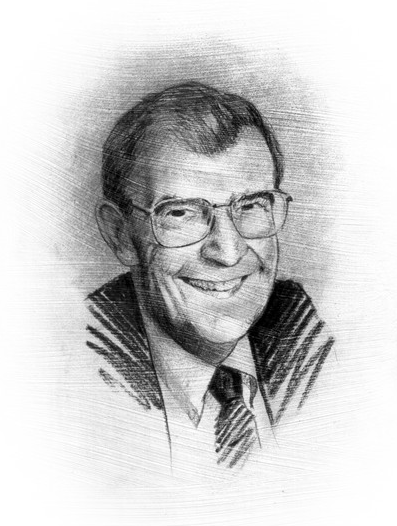
The visionary founder of Leidos celebrates his 90th birthday this month. Follow us on Dr. J. Robert Beyster’s life journey from renowned physicist to industry icon.
In 1969, with a few dollars and a good idea, visionary scientist J. Robert Beyster, Ph.D. founded SAI, the company that evolved into Leidos. The experience transformed Beyster from a physicist who once thought starting a company was “somewhat distasteful” to a leading proponent of employee-ownership and entrepreneurship.
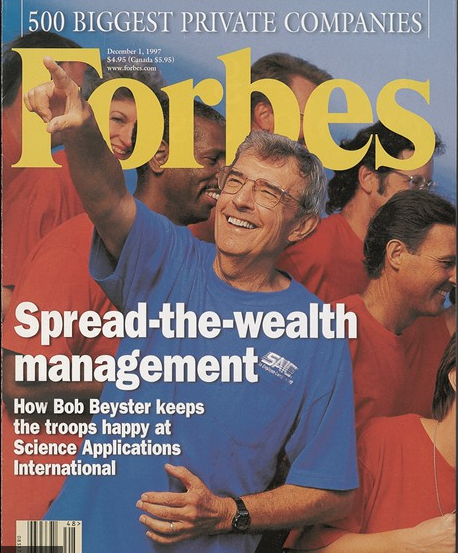
“J. Robert Beyster…has built one hell of a company.”
ForbesFrom Detroit to La Jolla
Born in Detroit, Mich., in 1924, Dr. Beyster grew up in nearby Grosse Ile. His father, a home designer and builder, lost his business during the Depression. He worked small design and construction jobs until finding work with General Motors.
As Beyster finished high school, the United States was entering World War II, and Dr. Beyster enlisted in the U.S. Navy. The Navy sent him to college at the University of Michigan, where he enrolled in the Navy’s V12 Officer Training Program. He was commissioned as an ensign, and eventually served on a destroyer based in Norfolk, Va.
As Beyster finished high school, the United States was entering World War II, and Dr. Beyster enlisted in the U.S. Navy. The Navy sent him to college at the University of Michigan, where he enrolled in the Navy’s V12 Officer Training Program. He was commissioned as an ensign, and eventually served on a destroyer based in Norfolk, Va.
[Photo: Dr. Beyster during his time serving in the U.S. Navy]
Founding Year
The Physicist
After leaving the service, Beyster returned to the University of Michigan, earning a B.S.E. in engineering and physics in 1945, a master’s degree in physics in 1947, and a doctorate in physics in 1950. His outstanding career as a nuclear physicist began as a scientist at Westinghouse, working on its nuclear submarine program. He left Westinghouse to work as a research physicist at the Los Alamos National Scientific Laboratory in New Mexico.

a
By 1957, he was chairman of General Atomics’ Accelerator Physics Department. As chairman, he established and managed a traveling-wave linear accelerator facility used for research on neutron thermalization, essential to nuclear reactor operations.
In 1967, Gulf Oil acquired San-Diego-based General Atomics and the focus moved away from applied physics research. Beyster left the company in 1968.
Gallery
“It was just supposed to be a good
place where I could work and maybe
a few people could join me.”
Annual Revenue ($Billions)
Employees
When Dr. Beyster retired in 2004, the company had annual revenues of $6.7 billion and more than 43,000 employees.
But it wasn’t easy. During its first year, SAI experienced the financial hardships common to many startups. Dr. Beyster had invested nearly everything he owned. Liens were placed on his and other employee’s homes to secure loans. The company experienced cash flow problems. “We always paid everyone’s salary, although mine was deferred for a few months,” Dr. Beyster recalled.
SAI weathered the storm, and after the first year, had brought in $243,000 in revenues.
“After a year, a surprising thing happened,” Dr. Beyster said. “We made a profit. I knew something must be wrong. We had a rather small board, and one of the board members said, ‘You know, Bob, you’d better get some help because you don’t know what you’re doing.'”
“You know, Bob, you’d better get some help
because you don’t know what you’re doing.”
As the number of contracts grew, SAI’s performance spoke for itself. More contracts began coming in and the company’s revenues went from $243,000 the first year to $1.2 million at the end of the second year.
By its 10th year, the company passed the $100-million mark.
Founding Year
The Entrepreneur
In February 1969, Beyster founded Science Applications, Inc (SAI). It began with Beyster and a small group of like-minded scientists working out of very modest offices next to a ballet studio in La Jolla, Calif. Dedicated to solving complex problems of concern to the nation, their first substantial contract was with the Defense Nuclear Agency, helping to analyze nuclear weapon effects. The scientists and engineers not only worked on contracts and interfaced with customers, they also took on the challenge of doing the marketing.
The company was renamed Science Applications International Corporation (SAIC) as it expanded broadly into national security programs, non-nuclear energy, healthcare systems, environmental business, information technologies, high-technology products, and transportation.
“Thirty-five years ago I was the manager of a self-supporting government contract research organization at another company. What I observed was that the government was not always getting the best technical support from private contractors on its national security projects,” Beyster said. “I found this to be unacceptable because our country needed the best help it could get in the national security area. So, providing quality work on national security problems at a fair price was the major motivation behind the founding of SAIC in 1969. I believe we have succeeded in this.”
An avid sailor, Dr. Beyster was active in support of the International America’s Cup Class sailboat races for many years. As a result of his efforts, SAIC contributed scientific talent and technology – much of it derived from the company’s work for the U.S. Navy – to U.S. syndicates that were either challenging or defending the America’s Cup over the last two decades. At the peak of his remarkable career, Dr. Beyster was featured on the cover of the December 1, 1997, issue of Forbes magazine, which said, “J. Robert Beyster has built one hell of a company.” Sharing the Success From the start, it was decided that the employees would own the company, and ownership would be based on a person’s contribution to the company. “Employee-ownership” became the byword. As the first year ended, Beyster’s initial ownership stake of 100 percent had dropped to about 10 percent. And the byword had become employee buy-in, a driving force in the company’s continued success. The first, difficult year ended on a high note. Not only were employees working on complex scientific problems in a company they considered their own, but SAI had made a profit, and a long history of growth began. The first year of operation, SAI had 20 employees and revenues of $243,000. Beyster was the company’s chief executive officer until November 2003. Fiscal year 2004 ended with revenues of $6.7 billion and more than 40,000 employees, making it the largest employee-owned research and engineering company in the United States. Beyster served as SAIC chairman of the board until retiring from SAIC, July 2004. “I had a very simple vision for the company in 1969. I wanted it to establish a place where we could work for our customers and do a good job, focus on the work, keep the costs down, and not be bothered by unnecessary bureaucracy and other considerations that made it hard to do research work. We happened to pick the right time to get going. A lot of good people were interested in finding such a place. Growing a large company was not in my head. I promised my wife it wouldn’t get over 4 people. Of course that changed pretty quickly.
“Growing a large company was not in my head.
I promised my wife it wouldn’t get over 4 people.”
Beyster has founded two nonprofit organizations dedicated to promoting employee ownership and entrepreneurship. The Foundation for Enterprise Development, founded in 1986, launched the Beyster Institute in 2004. Through a Foundation for Enterprise Development grant, the Rutgers University School of Management and Labor Relations awards J. Robert Beyster Fellowships to outstanding Ph.D. candidates or postdoctoral scholars in many fields who are studying employee ownership and related ideas.
Beyster authored or co-authored approximately 60 publications and reports, primarily related to nuclear physics. He also wrote extensively on employee ownership, including a book on building SAIC into a successful, employee-owned technology company (Link to The SAIC Solution).
Beyster served as a Fellow of the American Nuclear Society, Chairman of its Reactor Physics Division and Shielding Division and Fellow of the American Physical Society.
He was a member of the Scientific Advisory Group to the Director, Strategic Target Planning Staff of the Joint Chiefs of Staff and the National Academy of Engineering. He also was chairman emeritus of the board of directors of the University of California San Diego Foundation.
Beyster received many prestigious awards for leadership, service to community, and lifetime achievement. In April 2012, University of Michigan’s computer science engineering building was renamed to honor Beyster and his wife Betty. They married in 1955 and had three children. The building was rededicated as the Bob and Betty Beyster Building.
In 2013, the J. Craig Venter Institute (JCVI) recognized the Beyster family’s generous donations and long-time support for its genomic research, especially in ocean waters. JCVI’s sustainable laboratory, which is being constructed on the University of California, San Diego campus in La Jolla, will feature the Bob and Betty Beyster Conference Room and a Betty Beyster Terrace.
Beyster’s business legacy also includes two non-profits he started to help promote entrepreneurship.
- The Foundation for Enterprise Development helps governments and private organizations foster entrepreneurship as an effective social and economic strategy.
- The Beyster Institute for Entrepreneurial Employee Ownership promotes global entrepreneurship, employee ownership, and economic development through consulting, training, and international projects. It has been incorporated into the University of California, San Diego, Rady School of Management.
In 2004, J. Robert Beyster, Ph.D., retired as SAIC’s chairman. The board honored his 35 years of visionary leadership with donations in his name to both the Beyster Institute and the Foundation for Enterprise Development.
But retirement hasn’t been all boating and blogging for Beyster. In 2007, he co-authored The SAIC Solution: How We Built An $8 Billion Employee-Owned Technology Company, offering an inside look at one of the most successful research and technology companies in the world.
In 2008, Dr. Beyster was inducted into the Horatio Alger Association of Distinguished Americans, a unique honor acknowledging individuals who succeed through hard work and perseverance.
Meanwhile, the company he founded remains one that recognizes hard work and values its forward-thinking entrepreneurs.
Related Content
A Visionary Leader with a Lasting Legacy, Our Legacy, Our Leadership Team, Once a Pilot
Awards & Honors
As the result of his professional and business success, Dr. Beyster received an abundance of awards and recognition. Among his many honors:
A fellow of the American Nuclear Society, Dr. Beyster served as Chairman of its Reactor Physics Division and Shielding Division. He is a fellow of the American Physical Society, a member of the Scientific Advisory Group to the Director, Strategic Target Planning Staff of the Joint Chiefs of Staff, and a member of the National Academy of Engineering. He also served as Chairman Emeritus of the Board of Directors of the University of California San Diego Foundation.
The Defense Advanced Research Project Agency designated Dr. Beyster an Honorary Program Manager for his distinguished contributions to the agency over his career.
He received the Engineering Manager of the Year Award in 2000 from the American Society of Engineering Management, the 2001 Spirit of San Diego Award from the San Diego Regional Chamber of Commerce, the Lifetime Achievement Award from Ernst & Young in 2003, and the “Supporter of Entrepreneurialism” award from Arthur Young and Venture magazine — at their Entrepreneur of the Year awards ceremony — for his efforts to support and promote entrepreneurship.
In 2006, the San Diego Regional Economic Development Corporation recognized Dr. Beyster with the Herb Klein Civic Leadership Award for his outstanding leadership in addressing regional challenges through collaboration with public, private and civic partners.
Dr. Beyster received a lifetime achievement award from the University of California, San Diego’s CONNECT program for providing 25 years of outstanding service to the community. CONNECT also inducted Dr. Beyster into its Entrepreneur Hall of Fame for his professional and personal contributions to San Diego’s thriving technology community.
The Horatio Alger Association for Distinguished Americans selected Dr. Beyster to be a 2008 Horatio Alger Award recipient. This honor is bestowed upon those individuals who have overcome adversity to achieve great successes through the American free enterprise system.
Dr. Beyster has written or co-authored approximately 60 publications and reports, as well as his 2007 book, The SAIC Solution: How We Built an $8 Billion Employee-Owned Technology Company. In this book, Dr. Beyster provides an inside look at how SAIC became one of the most successful research and technology companies in the world.
What They’re Saying
“The great promise of the American economy, especially the high-tech economy, is its seemingly inehaustible supply of ingenuity, creativity, and breakthrough advances–innovations in computing, communications, software, and the life sciences that shape how we live, work, inform, and entertain ourselves. This country’s entrepreneurial spirit and our culture of technology-driven progress continue to be–rightly–the envy of much of the rest of the world.” – Foreword, The SAIC Solution
“In Dr. Beyster’s world, nobody wins unless everyone who contributed to the success of the organization wins.” – Foreword, The SAIC Solution
“Dr. Beyster, for all the years he ran SAIC, displayed beind his desk a poster given to him by his wife Betty. ‘None of us is as smart as all of us.’” –Foreword, The SAIC Solution
“As founder of SAIC, Dr. Beyster personified the American dream through his achievements as an entrepreneur and great visionary. The employee-ownership philosophy and entrepreneurial spirit Dr. Beyster established at SAIC were key factors in the steady growth and early success of the company.” – John Jumper
“J. Robert Beyster…has built one hell of a company.” – Forbes 1997
“What you have to respect is Dr. Beyster’s passion for the business. This company was his child. He nurtured it through enormous success. And again, you talk about someone who was part of something bigger than himself—this was the thing that was bigger than himself. He dedicated himself to the success of the company and employees. Those things served SAIC extremely well. It’s that dedication—the scientist’s attention to detail—and his personal love of this business he started that you just absolutely have to admire.” – John Jumper
1924 – Born
1945
Earns B.S.E. in engineering and physics from the University of Michigan
1947
Earns master’s degree in physics from the University of Michigan
1950
Earns doctorate in physics from the University of Michigan
1955
Marries Wife Betty
1957
Becomes chairman of General Atomics’ Accelerator Physics Department
1967
Gulf Oil acquires General Atomics
1968
Beyster leaves General Atomics
1969
Founds SAI
1986
Founds the Foundation for Enterprise Development
2004
Retires from SAIC
Launches the Beyster Institute
2007
Co-authors The SAIC Solution: How We Built An $8 Billion Employee-Owned Technology Company
2008
Inducted into the Horatio Alger Association of Distinguished Americans
2012
University of Michigan renames computer science engineering building to honor Dr. Beyster and Betty